


Syllabus: GS3/Defence
Context
- The Defence Minister has called for ‘Aatmanirbharta 2.0’ in the defence sector, with a focus on developing advanced technologies, strengthening research and development (R&D) and building resilient domestic supply chains.
Overview of India’s Defence Sector
- India’s annual defence production has surged to an all-time high of Rs 1.78 lakh crore in the Financial Year (FY) 2025-26. The milestone represents a 15.6% growth over the previous fiscal year.
- Sectoral Contribution: Defence Public Sector Undertakings and other PSUs accounted for approximately 76% of total production, while the private sector contributed 24%.
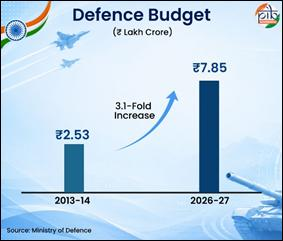
- Defence Budget Growth:The defence budget rose from ₹2.53 lakh crore in 2013–14 to ₹7.85 lakh crore in 2026–27.
- India is exporting defence equipment to more than 80 countries as of FY 2025-26.
- Defence R&D allocation rose from ₹13,716.14 crore in 2014–15 to ₹29,100.25 crore in 2026–27, an increase of over 112%.
- Surge in Indigenous Defence Production: 65% of defence equipment is now manufactured domestically, a significant shift from the earlier 65-70% import dependency.
- India targets ₹3 lakh crore in defence production by 2029, reinforcing its position as a global defence manufacturing hub.
Achievement in India’s Defence Self-Reliance: FY 2025–26
- Self- sufficiency: The Indian Army achieved roughly 91% self-sufficiency by indigenising 159 out of 175 ammunition variants in its inventory.
- Missiles: India has successfully tested the Agni-4 Intermediate Range Ballistic Missile and Agni-5 Long Range Surface-to-Surface Ballistic Missile.
- The TARA Glide Weapon and RudraM-II air-to-surface missile have also demonstrated indigenous precision-strike capabilities.
- Air-Defence Systems: The DRDO has advanced multiple indigenous systems, including the Kusha Long Range Air Defence Missile and Very Short-Range Air Defence System (VSHORADS).
- An integrated air-defence system combining missile interceptors, short-range weapons and laser technologies has also been successfully tested.
- Warships and Submarines: The Indian Navy commissioned 12 warships and submarines, including INS Surat, INS Nilgiri and INS Vaghsheer.
- INS Mahendragiri, stealth frigate, also entered service with over 75% indigenous content.
- Maritime Surveillance: SHACHI, the first of 11 Next Generation Offshore Patrol Vessels, launched. INS Dunagiri, INS Sanshodhak and INS Agray also commissioned, completing the indigenous Sandhayak-class survey fleet, expanding maritime surveillance.
Need for Defence Indigenisation Reforms
- Strategic Autonomy & National Security: It reduces dependence on foreign suppliers, especially during crises and geopolitical tensions.
- Addressing Capability Gaps: India faces complex security challenges across borders and in the Indian Ocean Region (IOR). Modernisation is required to replace ageing platforms in the Army, Navy, and Air Force.
- Reducing Import Bill & Promoting Economic Efficiency: India is among the world’s largest arms importers, indigenous production lowers costs in the long run, reduces foreign exchange outflow, and strengthens the domestic defence economy.
- Boosting Domestic Defence Industrial Base: Indigenisation stimulates innovation and growth of Defence Public Sector Undertakings (DPSUs), MSMEs, and private industry.
- Faster Procurement & Operational Readiness: Domestic manufacturing shortens procurement cycles and ensures timely delivery.
- Improved Customisation & Adaptability: Indigenous platforms can be tailored to Indian terrain (Himalayan high-altitudes, deserts, maritime zones) which allows continuous upgrades to meet evolving threat environments.
- Technology Sovereignty: Developing indigenous technologies ensures freedom in design, production, and future upgrades. It also prevents vulnerability due to sanctions, supply chain disruptions, or technology denials.
What are the Challenges?
- India continues to depend on imports for several advanced defence technologies and critical components.
- Research and development expenditure in the defence sector remains comparatively limited.
- Technological gaps exist in areas such as jet engines, semiconductors, cyber warfare, and advanced sensors.
- Private sector participation still faces regulatory and procurement-related challenges.
- Achieving global competitiveness in defence exports requires sustained investment and quality assurance mechanisms.
Defence Acquisition & Indigenisation Reforms
- Defence Procurement Procedure (DPP) 2016 streamlined defence acquisitions while advancing Make in India. It laid the foundation for subsequent reforms in defence procurement.
- Defence Acquisition Procedure (DAP) 2020 strengthened indigenous procurement and domestic manufacturing. It also expanded opportunities for Indian companies in defence design, development and production.
- DAP 2026 proposes simpler acquisition categories and stronger support for indigenous design and development. It also proposes indigenous content requirements of up to 60%.
- Till May 2026, 10 Positive Indigenisation lists, five each of DMA & DDP, covering 5,521 items were notified.
- Major indigenous acquisitions: Approvals include 97 Tejas Mk-1A fighter jets worth ₹62,000 crore and 156 LCH Prachand helicopters worth ₹62,700 crore.
- These procurements expand India’s domestic aerospace and defence manufacturing capabilities.
- Defence Procurement Manual (DPM) 2025 streamlined nearly ₹1 lakh crore in revenue procurement. It enabled faster approvals, relaxed penalties for indigenous projects and assured long-term orders.
- Srijan Defence Equipment Empowerment Platform (DEEP) is a digital repository promoting indigenous defence sourcing. As of May 2026, it listed over 41,000 vendors and 2.7 lakh products, strengthening domestic supply chains.
- Defence Industrial Corridors: Two corridors, Uttar Pradesh Defence Industrial Corridor (UPDIC) and Tamil Nadu Defence Industrial Corridor (TNDIC), are the lifelines of this transformation.
- By April 2026, the UPDIC had attracted ₹42,057 crore in investment commitments and the TNDIC attracted ₹32,699 crore of investment.
- The BrahMos Integration & Testing Facility in Lucknow has begun manufacturing missiles.
- By April 2026, the UPDIC had attracted ₹42,057 crore in investment commitments and the TNDIC attracted ₹32,699 crore of investment.
- Defence Testing Infrastructure Scheme (DTIS): DTIS aims to boost indigenisation by providing financial assistance for setting up eight Greenfield testing and certification facilities in the aerospace and defence sector.
- Seven test facilities are already approved in areas like unmanned aerial systems, electronic warfare, electro-optics, and communications.
- Boosting Innovation:iDEX & TDF Innovations for Defence Excellence (iDEX), launched in 2018, supports startups, MSMEs, academia, and innovators with grants and funding to develop technologies for defence and aerospace.
- Technology Development Fund (TDF) Scheme also funds industries, especially Start-ups and MSMEs upto an amount of Rs. 10 Crore, for innovation, research and development of defence technologies.
- Ease of Doing Business in Defence: Industrial licence validity has been extended from 3 years to 15 years, with a possible 3-year extension, making investment planning easier.
- The FDI limit in the defence sector was increased to 74% under the Automatic Route and up to 100% via the Government Route.
Way Ahead
- India should strengthen indigenous research and development capabilities in emerging defence technologies.
- Greater collaboration between DRDO, private industries, startups, and academic institutions is required.
- Defence industrial corridors and manufacturing clusters should be expanded further.
- Specialised skill development and training programmes should be launched to create a skilled workforce for emerging defence technologies.
Source: DD
Previous article
Media Association Challenges Digital Privacy Law
Next article
Cyclone Arnab
